Charlie Brown in the Third Grade

Ms. Hurley, why do you like Charlie Brown?

That’s what my third graders ask me every year.

God bless their hearts. They come into the third grade innocent. Taking everything at face value.

I never answer that question, because I never thought I liked Charlie Brown. I just think it’s a good tool to use to teach third graders about race in America.

Before school starts, I use my Amazon points to purchase classroom items such as posters, stickers, door décor, awards, window stickers and a new grade book -all decorated with Peanuts characters.

I found this Clean Desk Award on the website Teachers Pay Teachers. It’s a great way to teach the third grade organizational skills. I never have to worry about a messy desk. They never know when Ms. Hurley will give out the Clean Desk Award.

There is a huge welcome poster that hangs above the cozy classroom library. It’s the first poster the children see when they walk in. It says welcome in huge red letters, and features every Charlie Brown character-except Franklin.

There is a poster at the front of the room that states “In a good conversation, one person talks while the other listens,” and there you see Charlie Brown in a good conversation…

There is a Snoopy poster. It has a yellow backdrop and it reminds the children how to be a perfect friend. Lucy has a poster. Linus has a poster. There are posters with the whole gang- except Franklin. As a matter of fact, I can count on one hand how many posters Franklin is in…

So I ask the children to create a poster for Franklin.

As the year goes by the children mature. The calendar at the front of the room finally has a picture of Franklin…

Franklin’s image for the calendar appears on Martin Luther King, Jr. Day.

Around this time they are introduced to my Charlie Brown library.

I built the library by searching on eBay and Etsy for Charlie Brown memorabilia. I came across a set of old Charlie Brown books. They are so old the children have to ask special permission to read them and they MUST handle the books with care.

The ones who love to read try to keep them. Before they leave for the summer, I have to search their desks to make sure each one is returned.

During the year, I watch them silently read. It warms my heart to see them understand the humor from the Peanuts characters. Once they start to laugh and enjoy the content, I begin to ask them questions about the images and where they see themselves.

I then pull out the Charlie Brown dictionary- which always amazes them. (It amazed me too!) I add it to our classroom set of dictionaries. As time passes and they learn to define words and use them, I allow them to search the Charlie Brown dictionary.

As the year continues, the class grows older. The students are not new to third grade. They are fully third graders now.

Then one day, someone asks a question about identity – this always happens…someone is always curious about his or her self– and the class begins to argue and no one can come to a consensus. They turn to me and I turn to the dictionaries that they learned to trust and ask them if they ever looked up the words black or white. What do they think it means in a dictionary such as this one? I pull down the Charlie Brown dictionary.

The classroom is usually silent. Everyone thinking.

Then I flip the pages to white.

And read: White is the color of snow. Ducks have white feathers. The sheets on my bed are white. Marshmallows are white.
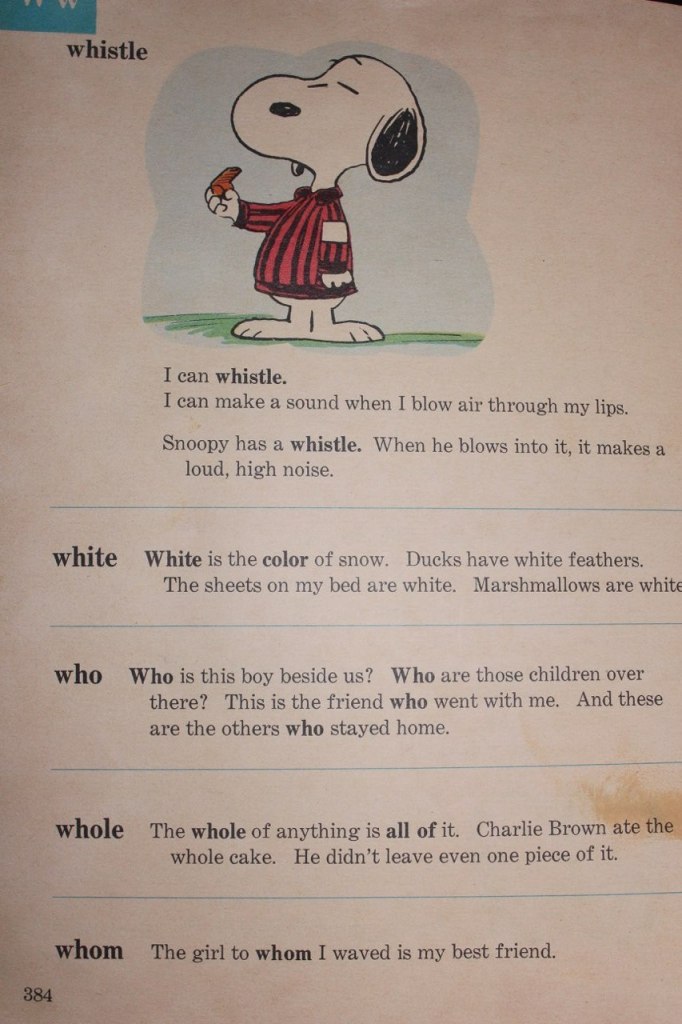
Next I turn the pages to black and read,

Franklin is Charlie Brown’s little black friend. He is talking to Charlie Brown on the telephone. Black is a color. Black is also another word for Negro, a person with dark skin. The words in this book are black.

The next thing that usually happens is a series of questions. Questions about what is in books and what images we accept without questions.

One year, the conversation happened after a trip to the New York Historical Society. The children were stunned to see a white educator – rather than a black one- teaching them about slavery in New York. They stood, uncertain, and couldn’t answer her questions. When we returned to the classroom, they expressed their discomfort with having a white educator telling them about their history.

Why did you feel uncomfortable? I asked.

Because, what was her ancestors doing when my ancestors were slaves? one little boy said quietly.

What do you think they were doing and why didn’t you ask her that?

A bossy girl at the front of the room replied, Because, that’s rude Ms. Hurley!

Why is that rude? Weren’t you uncomfortable? Was it okay for her to make you feel uncomfortable in your own skin? I’m not telling you to be rude. I am telling you to think. Think about your history and your stories and who is telling them and who will tell them if you don’t learn who you are.

Another year the conversation happened after singing the Black National Anthem. That was two years ago, when Trevor Noah and Roy Wood Jr. celebrated Franklin’s 50th year on the Daily Show. That was the same year the children learned the word stereotype.

Last year COVID happened right when the children started having the conversations. I thought, How can I introduce ‘race in America’ without the setting of the classroom? America quickly answered that question for me. Instead of discussing Franklin and Charlie Brown we cried about Floyd and Michael Brown, Jr.

An Artist Mother

When you are no longer grieving a loved one, it becomes your job to celebrate the life that has gone away from you. You are joyful about it because joy must be paramount to your life.

Most of all, death has a lesser sting when you celebrate it and I mean, celebrate. Celebrating the death of a love one feels good.

It’s not like celebrating one’s birthday or an holiday because it has a life of its own.

This is what happens every December. The month my dear Mother passed away- and the month she was born.

This time I celebrated her by doing what I was supposed to do- I went to class.

My professor sent the class a message on Canvas: today we will have a Special Guest. I thought,

I was planning on attending another event and skipping class altogether. However, in the past, the special guests proved to be indeed special.

I met a curator and a comedian who both lauded the class with stories of how they got their foot in the door and their careers running.

This guest, Canvas said, was the artist who published the comic strip, Being An Artist and Mother, named Lauren Weinstein.

I looked at her art and was moved. It was work we had already seen in the halls of Columbia.

Let me go see art and listen to an artist who highlights motherhood in her work. I thought while leaving my home.

After sharing that she dressed up to see us- to which we rubbernecked to scan her outfit- she pulled up her art on the screen.

When I became a mother, my art processing changed. I saw stories that needed to be told.

Motherhood opened up a new world to me of cartooning…

I love what I do and I love how I do it.

She showed us how she used her IPad and the significance of ProCreate and shared with us a graphic novel she was working on for 10 years.

Afterwards she asked us for our feedback about her work which I found most humbling considering her success.

I raised my hand and asked about the Black character and this led to a honest conversation about race and how to paint stories without being offensive to people or killing the authenticity of the story.

My friend, Paige, asked her what were some subjects she would stay away from when creating art which got the ‘that’s a good question’ comment from all over the room. This changed the conversation into a discussion about family and our duty to try and show family in good standing at all times. I listened to Professor Blake and Weinstein share how they protect their children from being exploited in their line of work. I thought:

Funny, that’s how mothers are. They have a strong sense of protection over their children. And even in the physical absence of a mother, I can still sense it. That protection itself becomes a part of your nature after a while.

Their rules to life itself begins to protect you.

My professor, Emily Blake, eventually started her lecture. She asked us to take out our projects we were working on.

Weinstein, who stayed for class, traveled to and fro and giving feedback on students’ work and ideas. Quite naturally after showing my work to my friends, we sat there giggling and speaking about anything from art to naming a baby.

Nah, babies need names not adjectives! I laughed. Can you imagine a baby named Resistance? I asked.

I actually like that name! That’s cool. Then we can shorten it to Res.

It was at the very end of class, when Lauren Weinstein made her way to our corner. She inquired about our work and even though everyone was packing up to go home, she sat next to me and asked me about my project.

My two friends who said they would wait for me left when they realized like me- this artist was truly interested in what I was thinking and doing.

I showed her my work and she inquired about the time period and gave me the idea to research the Liberator newspapers.

Look at the layout and read the ads or essays to see how your work should be laid down.

This was particularly useful for me as a writer and artist because it was the format that I had trouble with.

While looking at the images she laughed, I am from Boston and I know exactly where this is!

Her questions about the timeline made me think of how the work would be seen.

You’re integrating your students into the project…Your main focus is to show Black culture in Boston at the time and how schools got integrated.

She pulled out one of my student’s pieces from the pile and commented on it, making me change my mind of how I was planning to grade and present it:

I love this- this is like a map that this kid drew that gives you a sense …like this is the south…this is a plantation the student drew. I love this map.

Originally I thought, I’ll limit the pictures of plantations because enslavement in the north looked different from the south – or did it really look different? – but she highlighted that it was something about the kid’s thinking process and it shows through the map. The kid sees a plantation. This made me think of my over all goal which is to show how the scholars grasp this lesson on race and enslavement in the north during the early 17th Century.

Just like an artist, she left me with sound advice, keep the kids authentic voice in your project each step. You can even reread that childhood book- ( I can’t read it because I can’t remember it- I only remember the art. No matter how hard I try to remember the title or author….) for inspiration.

Just like a mother, she took time with me and listened to my ideas.

Of course I appreciated it but like all children there is always a part we forget. I can’t remember that book. Only the cat and maps!

I arrived home thinking of my Mom and spent the night searching the internet for the Liberator and the cat map book. Or was it a dog?!

76th National Book Awards

Smiling with Ibi Zoboi and Amber McBride

The event happened on a cold Tuesday night.

I took the wrong train and got off on the right stop. I walked into the auditorium after stopping by the table shifted book store.

I now carried 3 hardcover books plus the books I had in my bag to read on the train. I stood at the back of the auditorium and kept my bags and coat ready to make an exit at the end of the event.

But if course, I didn’t leave immediately.

Hannah V. Sawyerr, Author of Truth Is

Each author that shared, must have picked the best part of their book because I wanted to buy more. And I did!

I picked up two books from Young People’s Literature:

Ibi Zoboi’s (S)kin, and Amber McBride’s The Leaving Room.

Celebrating Professor Patricia Smith

After listening to Patricia Smith talk about her father and Mississippi, I just had to purchase her book of poetry, The Intentions of Thunder: New and Selected Poems. Her storytelling was sweet with sadness.

The nonfiction genre was difficult to pick from. I knew I wanted something but went back and forth between Jordan Thomas When it all Burns: Fighting Fire in a Transformed World and Claudia Rowe’s Wards of the State: The Long Shadow of American Foster Care. After listening to the finalists I decided that I wanted to hear more of the voice of Yiyun Li in Things in Nature Merely Grow. Her voice was pure grief but the writing technique sounded new.

Lastly for fiction, I bought A Guardian and a Thief by Megha Majumdar.

Art as a Happy & Calm Space

I went to an event last night and met a childhood star, Illustrator Pat Cummings, along with contemporary book artist: Nina Cruz, Selina Alko and Steven Savage.

Pat Cummings, just like Eloise Greenfield, is a heroine for all Black children. Their poems, narratives, art and dedication to the literary world for children of color is on an even higher status than The Very Hungry Caterpillar by Eric Carle. For, while The Very Hungry Caterpillar, introduced children all over the world to colors and counting; they introduced forgotten Black children (all over the world) to the world of books and self representation (along with their many contemporaries). Thus, when I saw Pat Cummings on the program, I made sure to clear my schedule and attend.

smiling with Pro. Andera Davis Pinkney (with an old Pat Cummings book in my hand that I got signed!)

Professor Andera Davis Pinkney was the moderator and started off by asking each illustrator to tell about themselves. Each illustrator pulled up beautiful books they illustrated and shared their art process. Selina Alko, a journalist like me, shared the most breathtaking journal. She created full page collages for each spread in an old journal. I watched in awe as she only showed us three spreads (it ended too soon!) and then showed us her images in her children’s book about Joni Mitchell.

I remember thinking, who is Joni Mitchell and I scanned the room and it seemed like everyone knew Joni. Little did I know I was about to find out….in class that night. (One of my classmates, Paige, spoke about a book she read and the book began with the character listening to a sad song by Joni Mitchell- then Paige spoke about feeling even more connected to the book because she also enjoyed Joni Mitchell).

Nina Cruz shared her books and spoke about digital art. I never saw her work even though I read books by her father Donald Cruz. She shared a book she wrote that I could have used last year when I did a fourth grade lesson on Richard Wright. She also shared a new book she is working on for older children entitled, Liftoff: How the Apollo Moon Mission made Alma Thomas’s art Soar. Then, the name Alma Thomas didn’t ring any bells but as I am writing I realize Alma Thomas is a favorite artist of one of my best friends.

The next to speak was Pat Cummings and she spoke with joy. Her voice was that of a visit to a favorite aunt’s house. Her anecdotes made everything about the event, homely. At one point, when I turned around laughing, another person in the audience caught my eye and while others settled down we continued to laugh. The following are pointers she shared with us for artist and writers who want to get their work published:

  1. Remember, Expression is Everything, little kids read people faces and body language,
  2. make every character in the book think they are the star of the book,
  3. build a world around the character,
  4. THINK, Surprise yourself and finally make it personal.

Lastly, we met Steven Savage who shared his clean and simple illustrations. He said he is wired by the “less is more” motto and ended his introduction by saying “My art is meant to be my happy, clean, calm space.”

“Wow!” I thought, “Imagine? Art as a job and also a happy, clean, calm space. What a thought!

My Hands

I sat in the hallway getting ready for the next class when a student walked up to me (I’ll keep her name to myself)!

Ms. Hurley, she said full of laughter, you don’t want to see my hand!

Her hand was bawled up into a tiny fist.

Humm, I said, putting my pen and books on the floor. Now I want to see it!

Her eyes darted between her classroom and the bathroom letting me know her teacher told her to wash her hands. The fact that she thought the situation was funny made me even more intrigued.

Nooooo!!! She wailed.

Please?

Nooo! You don’t want to see it!

I really do want to see it now! Please? I promise to keep hush -hush about it. I whispered. Then she opened her hand, which was full of love.

I absolutely love it. It’s a hand worth seeing!

She laughed and skipped to the bathroom to wash her lovely hands off.