An Ex- Essence Editor tells of her Experience

When Essence magazine was founded in 1970, Ed Lewis, Cecil Hollingsworth, Clarence Smith and Jonathan Blount knew the genuine importance and value of what they were doing.

The four Black business men who started what would exist as a critical magazine for Black Women, understood that the Black Women’s desire to be seen, respected and recognized could possibly become capital.

Ed Lewis, Cecil Hollingsworth, Clarence Smith and Jonathan Blount were confident in the future success of the magazine, yet they had no concrete direction for the philosophy of it.

The four men depended on the women they hired to create substance for Essence. This would be a magazine for, by and about the Black women in America. This way of thinking was revolutionary. Essence funded and founded something to service themselves. They hired themselves, supported themselves and even fired themselves so that their overarching idea could succeed.

In the early 1970’s, everyone who came to service the magazine, earnestly improved not only the magazine but the nation they were serving.

Editor Ruth Ross gave the magazine its label.

Editor Marcia Ann Gillespie gave the magazine its loyal consumers.

Editor Susan Taylor gave the magazine its longevity.

Unless reading the small print, it was impossible to know that Essence was founded by Black Men.

There is a lot about the magazine that is unknown. Another hidden but obvious gem is that Essence Magazine created jobs for many Black women. Outside of the popular editors who became super-stars in the Black community, Essence also gave jobs to writers, photographers, models, makeup artists, hairdressers, cooks, seamstresses, athletes, travel agents, and most of all mothers, wives, and sisters some who graduated college as the first in their family with little to no opportunity.

Mrs. Carol Reid- Rembert with Bisa Butler in 2023

Career at Essence

Someone Essence gave employment to was Mrs. Carol Reid- Rembert, whom I met last year at the Bisa Bulter show. She joined Essence in 1972, two years after it was founded.

When Reid-Rembert graduated from the Fashion Institute of Technology (FIT) in 1969, she was unemployed. She met childhood friend, Susan Taylor, at a Steven Burrows fashion show who said, “Carol, what are you doing now?” Reid- Rembert, in her early 20’s, was grateful when Susan Taylor, offered her a freelance position to write articles about sewing. This position would eventually become a permanent job.

A young, Mrs. Carol Reid-Rembert standing outside FIT wearing a self-made dress.

Reid-Rembert was nervous about writing but took the position that was created for her. She became Essences‘ first Home Sewing Editor under the name Carol Reid. It was a little position compared to the top executives but vital. Her articles boosted sells. Essence received many letters from women around the country who wanted to know more about different topics like, how to sew fitted knit pants for Black bodies, how to sew suits, how to create drapes for the living room, and how to make fun Kwanzaa gifts for the holidays.

Reid-Rembert said at “Essence, every day was a busy day.” She was busy from the moment she walked in until the moment she left. While she didn’t go to the office daily, she worked from home, sewing and answering fan’s mail. When she did go into the office, she’d stay there until midnight to help get the magazine’s material ready for publication.

A model smiling in a blouse made by Mrs. Reid-Rambant.

This was the beginning of the computer age and everything was still being done by hand. She’d write everything longhand, then send her work to an editor who would type it out on a type writer.

The fashion department was ran by Susan Taylor who had editorial meetings. She discussed page layouts and themes for Essence. The fashion department worked closely with illustrator, Glen Tunstall, a popular fashion editor who also worked for Women’s Wear Daily (WWD), a fashion newspaper that was well-known in the fashion publication industry and originally published weekly. Established in 1910, WWD primarily focused on fashion news, trends, and business insights. “Tunstall”, Mrs. Reid-Rambant said, “was a perfectionist who always gave me what I was looking for. There was very little reason to edit his work.”

Mrs. Reid- Rambant was paid for writing articles and making the garments connected to the article.

Essence at this time worked extremely hard to build their advertising revenue. Every creation, textile or pattern used meant possible income for the magazine. The garment company would send Reid-Rembant free samples so their names would be mentioned. She also worked closely with pattern companies such as Vouge, and Butterick Patterns, which she didn’t know then but eventually she would work for Butterick Patten as a grader supervisor (someone who size garments). Many people who purchased the magazine and read her editorials would also buy the patterns she suggested.

Having this position, opened up a world of opportunities. Not only was she able to work in the pattern industry, she also met many celebrities like Carmen De Lavallade and Geoffrey Holder, and held teaching positions at China Town Sewing Industry, Pratt Institute, and The Bronx Museum.

Essence encouraged DYI projects before the term became popular. Through Mrs. Carol Reid-Rambant, Essence encouraged their buyers to be resourceful and business minded.

This way of thinking is slowly resurfacing and Mrs. Carol Reid-Rambant is ready to be apart of the movement. She is currently searching for grants to fund a program out of the Marcy Projects teaching youth how to sew.

Backstory of Mrs. Carol Reid-Rambant

Mrs. Carol- Reid-Rambant was born 1948 in Kings County hospital. She grew up in Brooklyn in the Marcy Projects and her parents instilled in her a love for her people and culture. Her parents had come a long way both migrating from the South. Reid-Rambant was inspired by her resilient mother who at 16, left South Carolina after being threaten by Klans men.

Mrs. Reid-Rambant was 9 when she started sewing. She shared the following:

My mother asked me what I wanted for Christmas and I said a sewing machine. She thought I was talking about a toy and I said, no mom, a real machine! My mom then threaten me by saying, If you don’t treat it right, I’m returning it!

In those days, when you brought a machine, it came with free lessons and the company thought my mother was signing up for the class. When they found out it was a 9 year old girl, they said no. But my mother insisted that I also sit in the class and told them if they discriminated against me she was going to return the machine, thus, I was able to get sewing classes! It was a gift from God! Everyday I practiced and taught myself how to sew. I would look at the department store merchandise and try to copy what they did.

I went to Sarah J Hale High School, an all girl school in Brooklyn and took Fashion Design there. Upon graduation, the guidance counselor refused to write me a recommendation letter to FIT and told me she can help me find a good factory job. I told her- that’s not what I asked you! I went home and made 14 outfits! One being a suede suit that I wore. FIT accepted me on the spot. There were 3,500 White students, 35 Black students, 15 Puerto Rican, and 5 Chinese students in the whole school.

Before Carol Reid-Rambant graduated, FIT promised her placement in the fashion industry. But the school never called her nor any of her companions. She believed intrinsically in the nature of the time and was apart of Black nationalist groups in and out of school. She knew the school did not fulfill their promised because of her political behavior and beliefs.

While in school, she was apart of the first group of students who created the Soul Club. They challenged the school to enroll more Black, Latino and Asian students. They also traveled to Harlem teaching young girls about their culture, how to sew and how to do hair.

Outside of sewing and activism, young Reid-Rembert also enjoyed dancing. Her mother, a southerner from South Carolina, who knew how to cook would invite the young people into her home where they would eat and socialize. She said, “my mother’s wisdom was- the youth was in her house so she knew the whereabouts of her own children.”

Reid- Rembert met other young people who were Black-centric and apt to Black power methods.

It was through this crowd of people that Reed- Rembert met Susan Taylor who wasn’t yet working at Essence. She and Susan became friends and would see each other frequently at the Pallidum, a popular Latin club.

Reid- Rembert became known as one of the best dancers at the Pallidum and could have considered a career as a dancer. As a matter of fact, in 1974, Ellis Hazelip, the producer of Soul Train, invited her to perform on his show on Channel 13!

Joining Essence, she understood the need for the magazine and poured everything she could into its production. Her goals for the magazine aligned with the time. She said the following about joining Essence:

Mrs. Reid- Rembert at Sea Restaurant in Brooklyn.

“This was an age of change in the Black culture and community. We walked around calling each other brother and sister and cared about one another. I wanted people to understand that they are capable to do whatever it is that they want to do. Malcolm X had influenced me! It was my first time hearing someone say the things he said. I wanted to be apart of the change happening. “

Essence was created during a time of urgency and union for and by Black people and each person who joined or subscribed, made the need evident. The Black women who joined the magazine gave it substance. It worked because it was very apropos of the time and easy to believe. It help put what was known in the heart, in the physical, national world.

It is Well with my Soul

(This image is from a NYT article dated June 2022 and is drawn by Sammy Harkham)

I am currently reading, Four Hundred Souls: A Community History of African America, 1619- 2019 edited by Ibram X. Kendi and Keisha N. Blain. While reading part seven of the collection, I came across, Reconstruction, by Michael Harriot. The essay reminded me of Sunday morning service and thinking of Sunday’s service made me write the following post.

The except that inspired me reads:

The hero of this drama is Black People. All Black People. The free Blacks; the uncloaked maroons; the Black elite; the preachers and reverends; the doormen and doctors; the sharecroppers and soldiers- they are all protagonists in our epic adventure.

Spoiler alert: the hero of this story does not die.

Ever.

This hero is long-suffering but unkillable. Bloody and unbowed. In this story- and in all the subsequent sequels, now and forever- this hero almost never wins. But we still get to be the heroes of all true American stories simply because we are indestructible. Try as they might, we will never be extinguished.

Ever.

Harriot continues his essay describing the fight for life, and political freedom during this tumultuous time in America. He tell us of the many murders that took place, and about the three major attempts to put an end to the Klansmen.

Somewhere inside of my psyche, Harriot’s historical account and my experience on Sunday made a connection.

Before I tell you about Sunday, I must tell you about Bis (changed his name for confidentality). We met as children. He is the 15th child of his family and I consider him a little brother.

Outside of being handsome, he’s an extremely kind person and very brotherly. He’ll open the door for sisters, carry heavy boxes, and greet everyone with a charming smile. What I enjoy most about his character, is that he is one of those brothers who can sing and isn’t afraid to do so. And chile, he can saaang. It is not a surprising fact because; mostly everyone in his family can sing. (Not even kidding- one of my close friends who came to church was mesmerized by his mother’s voice).

On Sunday, however, when Bis begin singing; his voice was that of an old man who smoked for many years. I turned around to see who was singing and was shocked that it was him. He must be in pain, I thought. I looked into his eyes. His young, carefree spirit seemed to be holding on to something greater than himself.

I cried and cried and I can cry some more if I think about it all.

He started singing Your Grace and Mercy by Frank Williams. I heard Bis’ mother singing along. She was lining out each word with a motherly wail; which made me cry even more. His beautiful sisters surrounded him, singing and crying too.

The song ended and he shared his testimony with the congregation. He arrived at his doorstep and while entering his building, was shot in the neck. God kept him alert and aware of everything in the moment.

He knew he was shot.

He knew he should seek help.

He ran for his life in the direction of the hospital. On the way, he spotted an ambulance truck. He banged frantically on the door and on the side of the truck. The two sleeping EMS workers took one look at him, and didn’t inquire or offer to help.

He tried talking with his hands. Making symbols.

Heart!?!!

Shot!!!!

Gun!!!!

But, nothing would do. They wouldn’t open their doors.

He gave up on them and ran the rest of the way to the hospital- Ten NYC blocks.

They rushed him into the emergency room. They told him the bullet traveled to to his shoulder, and eventually to his back. But- he had very little bleeding. Already his body was growing around the bullet and fighting off the new intruder.

“You’re a lucky man”, the doctor said to him.

“The bullet”, he was told, was “a stray cop bullet.”

A cop bullet? I looked around at others. Most people had their heads bowed. There wasn’t much noise. No amens or hallelujahs. Nothing. The Holy Ghost Fiery church was listening… with sorrow.

I thought, how many innocent people a year are killed by cops? Is he really a lucky man? Will the cops be moved into a new community to practice getting their target? Did the target look like him? Will they find the gun, trace the fingerprints, and hold the person who pulled the trigger responsible? Or is he lucky to have the innocent bystander story of I was just walking into my building when I got shot?

Also, is any money being made on account of his luckiness in getting shot? Is he getting a huge sum that will pay for any damage? I know the doctor is getting paid, the the ambulance drivers are getting paid and the cops are also getting paid; but what about his mother and her now new job of having to care for this young man and his days of missing work?

Is this all luck? Is luck to be Black and not die from a stray bullet? Blacks die from stray bullets and have been dying from their stray bullets since the beginning of the war they started in 1869.

After struggling for his life, Bis was released home. He is still recovering and rejoicing for another chance at this thing called life.

Everyone was impacted by his testimony and the mood of the sanctuary was now changed. The ex-cop who sat behind me held her head down. Not just down, but her entire torso was bent over and grunts could be heard as Bis spoke.

Young sisters thought of the safety of their brothers and brothers thought of the safety of their sisters because who’s exempt from a stray? No one was ever exempted from the noose. No one is exempt from a stray.

Mothers. Mothers. Black Women. Their pain was uncovered as Bis spoke and spoke.

What a powerful testimony, one mother said as she resumed her seat by her husband. She stood frozen by the entrance. Listening.

Bis spoke of his worry of being able to use his limb, his nervous system, his respiratory system…systems. Will his body ever be back to normal?

I thought of another brother who was also shot. I was sympathetic to his personal tragedy. He said he had two bullets in him which sounds frightening. The word lucky never came to my head. However, feelings of anger came to me.

While Bis was sharing his worries with the church, I remembered the agility of the other brother and was comforted to know that perhaps Bis will be okay in the long run.

The service continued and the Minister called on Sister Williams. She started singing the 1871 hymn by businessman Horatio Spafford. Spafford needed comfort in his situation of mourning the death of not only his son who had passed due to the Great Chicago Fire but also the death of his four daughters who had died the following day while trying to escape the fire engulfing their community. Once again, young people trying to escape fire. It was as if God himself was using the same Spirit to calm the fears of the congregation.

When peace like a river attendeth my way/ When sorrows like sea-billows roll

Whatever my lot,/ Thou has taught me to say,

It is well, it is well with my soul.

Her soprano reached up and called, and the church responded

It is well, It is well, with my soul.

In no account do I see luck or chance but a lot of fiery trails. A lot of running and a lot of people determine to live in-spite and despite of.

The essay by Harriot ends by telling us that even through it all, the most magnificent part is Black people in America still exist. Every imaginable monstrosity that evil can conjure has been inflicted on this population, yet they have not be extinguished. The hero remains.

Still.

And that is the most wondrous part of all.

Sunday I cried and cried and I can cry some more if I think about Sunday Morning service while reading Reconstruction by Michael Harriot.

The Talk

I borrowed Darrin Bell’s The Talk from the library and read it while eating dinner tonight.

I appreciate the labor process he must have went through to share his experiences through art and literature. He did an incredible job. Even though the topic is heavy there are moments of joy and laughter which is what life is about.

When I read his Jewish mom asked his dad to drive them to an apostolic temple, the story had me hooked.

At the end of the Pulitzer Prize cartoon- biography ( I know it’s a graphic novel) I wondered if my brother ever got “The Talk” from our father because I certainly never sat down to any type of talk. Maybe it’s because I’m a female or maybe I did get “the Talk” in a more linear form. All through my childhood and into adulthood I’ve been given the “Talk” and I just took it for granted.

Can someone take a talk for granted? Is it something to take for granted? is the person who doesn’t get the “Talk” free in any way?

Anthropomorphic Characters

Picture Walk

While reading A Wrinkle in Time, we meet all sorts of interesting characters from history and literature.

Along the way we meet the White Rabbit a fictional and anthropomorphic character in Lewis Carrol’s book, Alice’s Adventures in Wonderland.

When I explained the term anthropomorphic character to my students I understood that the characters are animals with human characteristics, however, they stumped me with the question- are monsters anthropomorphic?

Some sites say they are and others say they aren’t. I am not sure.

I think they should be. So I gave my students credit for animals and monsters.

Thank You, Ms. Renee Watson

watson

This public thank you letter is long overdo. Since this picture in 2019, I have seen Ms. Waston on many occasions and said thank you personally but putting it in writing has helped me shape the deepness behind my ‘thanks’.

Dear Ms. Watson,

This letter is about your involvement with the Langston Hughes’ house even though it was for a short period of time in which you (along with friends) made it into a community reading space.

It was in that short time, my interest in Langston Hughes sparked.

At the events, I met many writers such as the children’s book authors, Mr. and Mrs. Lesa Cline- Ransome, who wrote the book, Finding Langston and Mrs. Rita Williams-Garcia, the author behind the creation of the Gaither girls.

Meeting these authors and talking about their work in real time, was very pertinent to me as a teacher and writer. I did not know it then, but my school would soon be forced to relocate and my students would need as much of Langston Hughes and the Gaither girls as they could possibly have.

Last spring when the flowers were beginning to bud in front of the school building, the entire community was hit with terrible news- the school will be relocating. This shocked everyone. We were at our location for over 15 years. This news put everybody in another mode of survival (we were still coping with COVID-19). From the school’s administration to the children, plans had to be made and arrangements had to be set for the future.

As a teacher, one main thought of mine was, if the school remains open, whom can I teach next year that will open up discussions about displacement, gentrification, and Black migration in the U.S?

Because I had been involved in conversations about those very topics at the Langston Hughes House, it was easy for me to think of Hughes’ childhood and migration. I could think of no better person than this writer and renaissance man to teach and open up these tough discussions.

When putting together a syllabus for the school year, Langston Hughes’ children literature was sought after. Finding Langston by Lesa Celine-Ransom which deals with many relevant themes such as death, migration, poverty, Blackness, country living vs. city living and survival, wasn’t hard and it was the first book on their list. Gone Crazy in Alabama, was the last.

The children started Finding Langston at the same time the moving men started to pack the classrooms.

They read about Langston moving from Alabama and imagined they were in Langston’s shoes….The moving men were outside the classroom doors toting things away and they were in the classroom sitting on the floor with their legs crossed imaging they were on grass under the hot Alabama sun. Langston became us and we became him.

Learning about Langston Hughes and remembering the past conversations gave me a solace.

The students begin to bottle up their emotions and tried to process what was really going on. Their school building along with their friends and the comfort of common community was all being taken away.

Knowing the tough time they were experiencing, I drew from facts of Langston Hughes life and Black Life in general. For the rest of the year, we looked at Jim Crow laws, Brown Vs. Board of Education, Thurgood Marshall’s Life, Jacob Lawrence’s Migration Series, and at the end of the year ended with the Black Panther Party and the 10 point system.

Langston Hughes was a child of the Great Migration. Our parents (my parents at least) were apart of the same migration.

But my students and even myself are apart of another type of migration, gentrification. It seems to be the same story, and the same folks.

Thank You Ms. Watson for providing me the tools to have these conversations.

Ms. Hurley

Tree Roots among the Suds at Zambo Aroma

“When Angel was born,” Tree recalled, “he had really bad eczema.” I was standing in Zambo Aroma listening to Tree Alexander speak briefly about his business. 

“The doctors gave us some prescriptions which only caused more discomfort. So, I created our eczema care cream and rubbed him down four times a day, and his skin cleared up in six weeks. When the eczema care cream worked for Angel, everybody else wanted some and that started the snowball effect.”

 As I stood there, I enjoyed the aroma of the large spacious shop on 3848 White Plains Road in the Bronx. Smells of faint incense, sweet fragrance and woodsy herbs created a sense of tranquility. My eyes wandered throughout the homely lit shop and took in the images of the prominent Black figures.

The popular photo of Victorian era, Ida B. Wells with her natural hair pulled up into a bun is framed and sits on the ledge of a shelf. There’s also photos of Dr. Carver Washington, Dr. Sabi, and Madam C. J. Walker. There are holiday decorations up and as if playing Finding Waldo, there are many mini figurines of Black Santas, standing erect in several corners.

Towards the front of the shop sit two decorative love sofas and a small coffee table. There is a little girl swinging her legs back and forth as she looks down at a tablet. Along the wall are wooden shelves holding all sorts of products: plastic wrapped naturally made soaps, soy candles, sweet smelling scrubs, skin care cream, fabric sprays, and even handmade laundry detergent. 

Tree Alexander and some members of his Family

It was the day before Thanksgiving and the shop buzzed with Tree’s family members. Besides the little girl, Tree’s sons sat nearby playing video games and Tree’s father, Darryl, who was visiting from the city of Chicago, walked about putting smiles on people faces.

Tree Alexander, who is a parent of 5, and a social worker by profession, went to school for cosmetology. However, it was only when his son, Angel, was born that his dream of soap making as a profession began to flourish.   

“Business is really good,” Tree says with a smile on his face.”We started this business without a funder, investor or loan. We used all of our pocket change.” 

Tree spoke while pulling soap samples out of a jar and stuffing them into a clear plastic bag that held my previously purchased soy candles. He gave me bits and pieces of his story as a business owner and as a Black American. 

“I stood outside of this building when it was empty and sold soap on the weekends to save up enough money to get into this space.

Just like Ida B. Wells, Tree traveled, investing in his art before settling down in a new city as a Social Worker.

“I moved to New York when I was 19 and after spending all my money trying to become a broadway star, I practiced social work for ten years.  After I brought my first property and the kids started to come, I decided I wanted to work for myself….and this is what I always wanted to do…”  

I don’t own the property but that is my next step.” 

Tree Alexander packing soap and candles with a Black Santa sitting on the register .Opposite are flyers from community organizations

“Currently, We are doing very well. We have orders from up and down the east cost. We get a lot of business from Georgia and North Carolina. In addition, a lot of my products are made with ingredients from CSA’s and Black owned farms. We get shipments every day from Connecticut and New Jersey.” 

Sitting on the counter are flyers of community activities that take place at the store. I take a card for a book club and this reminds Tree of the other side of his business.

“In addition to skincare, we host, paint and sips, book clubs, and Zumba classes. There was no way I was going to start a business and not include the community!”

Tree looks at the soaps sitting on the shelf and put more gifts in my bag.

“This is a gift.” He says while wrapping it. “It’s a wild oats soap. The bar is made with olive oil, oatmeal and activated charcoal…. It’s a very conscience business I want to provide. Our mission is to provide health, healing and education…Not only are our products naturally made but all of our soaps have quotes or affirmations on the labels.” 

Naga Warrior products, the most popular product at Zambo Aroma

I pick up the soap bar I purchased, Naja Warrior bar, It reads: Purify and stimulate the conscious mind, memory, and mental performance.

“The Naga Warrior bar tells the story of the African civilizations which are found in South East Asia. These communities are connected to the foundation of Buddhism. They historically traveled on the monsoons between Africa and Asia. This is our most popular soap.” Naga bar which goes for $10.00 a bar on their website. 

“Our lavender deodorant talks about the American southern route, which was like a trade route for Black people.” When asked who did the writing, Tree acknowledged his team. “Carlton, my partner, is the writer, he makes everything possible virtually, he does all the websites and social media and I am in the kitchen”. 

Showing his generosity, he adds more soaps to the bag.

Tree, “I think that’s enough now,” I said laughing.

“Well, just in case you have friends!” He responds.

While Tree does most of his business in the northeast; his humble beginnings started in the Ida B. Wells projects in Chicago. 

Tree was born in the heart of Chicago, in Brownsville. The town named for the people who lived there. The same town Harlem Renaissance writers like Gwendolyn Brooks, Countee Cullen and Langston Hughes wrote about in their poems. 

Tree lit up while talking about the history of  his hometown. “Brownsville is in the south side of Chicago and runs directly into the Ida B. Wells projects and that’s where the clubs were back in the day. That’s where you went shopping and went to church! Aretha Franklin’s father was associated with that area so you know, the churches were packed! All kinds of stuff happened there!

As a child, Tree’s father taught him about his roots in Chicago through family stories and Black literature. He was exposed to writers like George Schuyler, Richard Wright and Langston Hughes.

“I read Black no More in the 6th grade. I would never forget that story. I now, reread the stories my dad had me read as a kid, I always find something new.” 

When I mentioned that I’ll look up the books on Amazon, he offered to lend me his books pulling them out of his library.

He continued, “I love my city. I would definitely go back to do business and networking. But I don’t think I would go back to live. Brownsville is a lost neighborhood now. Most of the stores are closed and boarded-up. It almost looks like other lost American cities. It’s rough. It’s not the same as it was before.” 

His father, walked into the shop and stopped by the counter to join the conversation. 

“Brownsville?!” He shouted in a teasing manner. “What you know about Brownsville?” Where you from?” His father asked me, making me laugh.

“I am from the Bronx.”

“Where is your family from?”

“My mother is from Gloucester, Virgina which is-“

“Oh, don’t tell me. I’m from Hampton Roads too! I know about Hampton and Norfolk. I was in the service down there! I was at Langley – you know the movie Hidden Figures? about the Black sister with the math? I was at Langley Hampton and I ate at that same cafeteria Taraji ate at in the film!”

Tree’s Father spoke fast and comical while sharing his very serious story about being a Black man in the service. His son looked on and smiled.

“I can’t believe you had your son reading Richard Wright when he was in the 6th grade sir!” I said when I could squeeze a line in. “I can’t even read Richard Wright without shivering now!”

He took a breath and in a serious, teaching tone replied, “Well, It’s important. Every Black boy needs to know about Bigger Thomas. They need to know that eventually you get caught for your dirt. That image needs to be embedded in their minds.” 

Perhaps its true images that are embedded into Tree’s mind which are still carrying him today.

Sometimes images of pain and dispair can help create images of health and hope.

No doubt, fundamentally, Tree’s images are connected to his roots which enable him, as a practicing cosmetologist, to use his psychology skills as a community builder. I am almost certain these Images are connected to Brownsville, Bigger and the Bronx which helps him persevere as a business man.

Perhaps those images seem like one large piece work of art – moving, yet still- and even though it can be difficult at times to pull apart Ida from Chicago or separate nostalgia from the future, bringing them all together is what matters because its the root of the mixture that creates the Zambo Aroma.

Charlie Brown in the Third Grade

Ms. Hurley, why do you like Charlie Brown?

That’s what my third graders ask me every year.

God bless their hearts. They come into the third grade innocent. Taking everything at face value.

I never answer that question, because I never thought I liked Charlie Brown. I just think it’s a good tool to use to teach third graders about race in America.

Before school starts, I use my Amazon points to purchase classroom items such as posters, stickers, door décor, awards, window stickers and a new grade book -all decorated with Peanuts characters.

I found this Clean Desk Award on the website Teachers Pay Teachers. It’s a great way to teach the third grade organizational skills. I never have to worry about a messy desk. They never know when Ms. Hurley will give out the Clean Desk Award.

There is a huge welcome poster that hangs above the cozy classroom library. It’s the first poster the children see when they walk in. It says welcome in huge red letters, and features every Charlie Brown character-except Franklin.

There is a poster at the front of the room that states “In a good conversation, one person talks while the other listens,” and there you see Charlie Brown in a good conversation…

There is a Snoopy poster. It has a yellow backdrop and it reminds the children how to be a perfect friend. Lucy has a poster. Linus has a poster. There are posters with the whole gang- except Franklin. As a matter of fact, I can count on one hand how many posters Franklin is in…

So I ask the children to create a poster for Franklin.

As the year goes by the children mature. The calendar at the front of the room finally has a picture of Franklin…

Franklin’s image for the calendar appears on Martin Luther King, Jr. Day.

Around this time they are introduced to my Charlie Brown library.

I built the library by searching on eBay and Etsy for Charlie Brown memorabilia. I came across a set of old Charlie Brown books. They are so old the children have to ask special permission to read them and they MUST handle the books with care.

The ones who love to read try to keep them. Before they leave for the summer, I have to search their desks to make sure each one is returned.

During the year, I watch them silently read. It warms my heart to see them understand the humor from the Peanuts characters. Once they start to laugh and enjoy the content, I begin to ask them questions about the images and where they see themselves.

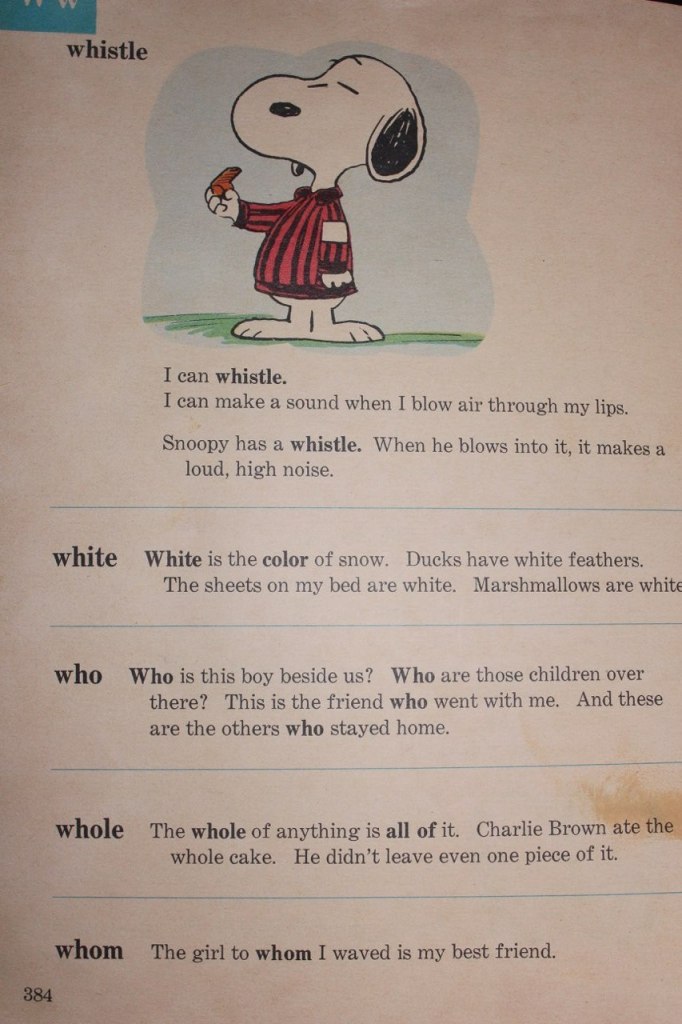
I then pull out the Charlie Brown dictionary- which always amazes them. (It amazed me too!) I add it to our classroom set of dictionaries. As time passes and they learn to define words and use them, I allow them to search the Charlie Brown dictionary.

As the year continues, the class grows older. The students are not new to third grade. They are fully third graders now.

Then one day, someone asks a question about identity – this always happens…someone is always curious about his or her self– and the class begins to argue and no one can come to a consensus. They turn to me and I turn to the dictionaries that they learned to trust and ask them if they ever looked up the words black or white. What do they think it means in a dictionary such as this one? I pull down the Charlie Brown dictionary.

The classroom is usually silent. Everyone thinking.

Then I flip the pages to white.

And read: White is the color of snow. Ducks have white feathers. The sheets on my bed are white. Marshmallows are white.

Next I turn the pages to black and read,

Franklin is Charlie Brown’s little black friend. He is talking to Charlie Brown on the telephone. Black is a color. Black is also another word for Negro, a person with dark skin. The words in this book are black.

The next thing that usually happens is a series of questions. Questions about what is in books and what images we accept without questions.

One year, the conversation happened after a trip to the New York Historical Society. The children were stunned to see a white educator – rather than a black one- teaching them about slavery in New York. They stood, uncertain, and couldn’t answer her questions. When we returned to the classroom, they expressed their discomfort with having a white educator telling them about their history.

Why did you feel uncomfortable? I asked.

Because, what was her ancestors doing when my ancestors were slaves? one little boy said quietly.

What do you think they were doing and why didn’t you ask her that?

A bossy girl at the front of the room replied, Because, that’s rude Ms. Hurley!

Why is that rude? Weren’t you uncomfortable? Was it okay for her to make you feel uncomfortable in your own skin? I’m not telling you to be rude. I am telling you to think. Think about your history and your stories and who is telling them and who will tell them if you don’t learn who you are.

Another year the conversation happened after singing the Black National Anthem. That was two years ago, when Trevor Noah and Roy Wood Jr. celebrated Franklin’s 50th year on the Daily Show. That was the same year the children learned the word stereotype.

Last year COVID happened right when the children started having the conversations. I thought, How can I introduce ‘race in America’ without the setting of the classroom? America quickly answered that question for me. Instead of discussing Franklin and Charlie Brown we cried about Floyd and Michael Brown, Jr.

Meeting John Lewis

Yearly, I attend book events. Especially children and young adult book events. One evening, I attended an event at the New School without doing my research. I just showed up to listen to the different authors and illustrators read from their stories.

I sat in the back and kept my eye on the time. It was a weekday and I had work the next morning.

That night Congressman  John Lewis, Andrew Aydin and Nate Powell were given the National Book Award for Young People Literature.

That night, I was completely mesmerized by Joh Lewis’ speech. His voice coming over the podium was so strong. I’ve been to many book events but this one by far was the first one that brought me to a special place. The voice said church, family, country, past, present, future. In a way it even said me.. I sat upright and looked at the program again.

Is that John Lewis? The one who marched with King?

To sit in his presence at that moment in time was a gem.

When he finished speaking, the entire house stood up and clapped and clapped.

I didn’t even know he was sharing his story via graphic novels.

After the event, he stood around shaking hands and speaking to the book lovers. Everyone stood around outside talking in the autumn breeze. Of course, the man of the hour was John Lewis. Young people listened to him and revenced him.

Thank You, I said to him before he signed my book and then again afterwards.

Thank you.

I’m grateful God allowed me time and space to share my gratitude with the Civil Rights leader while he was alive. Even if all I could think of saying was, Thank You.


Learning (and teaching) the History of Route 66

TaylorMy curiosity about the history of Route 66 was sparked by my third grade students.

During the lessons,  I could not answer many of their questions; therefore, I conducted a lot of research before and after each lesson.

I was grateful when I came across  Ruth and the Green Book by Calvin Alexander Ramsey which was/is  a great resource….and I want to say, the only one for children covering this topic.

(I find that sometimes when teaching the history of my people, not a lot of material is out there and if it is, it’s not for children. Which most times, is okay with me because I think children should be told the same story adults are told. Especially when these children are black and brown children who are taught to have a double conscience…)

So, for lessons about Route 66, YouTube came in handy. They watched Candancy Taylor’s documentary on Route 66 and I was blown away by what they understood about a time period that came before them (and their parents)!

Are blacks allowed to travel on Route 66 today? What’s redlining? What happened to Route 66? How does a road disappear? So, there are absolutely no businesses there now?? What happened to the black people? Do you think Nat King Cole took Route 66?

Without Taylor’s research I don’t think I would have been able to answer most of their questions so efficiently.

After the year ended, I had forgotten about the videos and Taylor’s research. Then, one day  in January, I received an email from the Schomburg inviting me to Taylor’s book signing.

Of course, I didn’t turn down a chance to meet the author and buy her book.  Overground Railroad: The Green Book and the Roots of Black Travel in America was finally on the shelves. I told the now fourth graders about her success, to which they were jealous they couldn’t attend ( but couldn’t wait to see that book was signed to them)!!

I called a couple of my friends who I knew would appreciate the topic and we met at the Schomburg to listen to Taylor speak about her research.  IMG_2822

I was already familiar with some information, since I had watched her on YouTube so many times before. Nonetheless, hearing her speak in person meant a lot to me.

One of my favorite stories she tells is the one of her step-father Ron (which is at the beginning of the book) and how the project brought them closer. When she started the project, he opened up to her about what he had been through as a black man traveling through America. After he passed, she found the courage and grace to continue her research.  This story resonates with me for many personal reasons. It makes me think of the sacrifices of my parents and grand-parents and the stories they took to the grave with them (or shared) about what they experienced. Likewise, it also resonates with me because of social reasons. It reminds me of the many historians who dedicated their life to documenting and researching topics that are out of the ordinary.

The night of the book signing we didn’t mind waiting over a hour (Ishita waited till the last minute to pick up a copy) to get our books signed.

When I met Ms. Taylor, she was extremely kind and patient. She listened to my story about my students and told me she is also writing a book for children (thank God!).