Happy Birthday to one of my dearest friends and business partner, Thembi.
Once upon a time I taught in a small, tiny classroom in the right wing of the school. Lockers and children crowed the hallways. Parents pushed their contemporary strollers pass my room to the kindergarten and preschool rooms. My room was filled with third graders who rightfully considered themselves older than the young, excited children who looked at my third graders with wonder and respect.
Those hallways took a while to resume to tranquility. There was never a dull moment. All who walked pass wanted to go to the third grade and those in the third grade were popular and most happy.
I was happy too. Young and excited every day about teaching. I taught my children how to bake homemade biscuits and hung their hand made piñatas in the classroom. Their plants sat on each window sill and we read every book we could get our hands on about our history.
Eventually, in that room, walked in classmates from Thembi’s youngest daughter’s class. They all stopped by for a high five. Pretty soon, everyone was slapping fives and when parents would come they had to stop by to slap a five with Ms. Hurley and this is how I eventually met Thembi. By children slapping fives.
The fourth and fifth graders took a trip to the Bronx Museum. It was a wonderful joyous event. They visited many different museums throughout New York City but never visited a museum to meet up with a friend of their teacher.
Mr. Cook and I met a couple of years ago in Brooklyn at Prospect Park. I traveled there to see Art in the Park. When I arrived, I ran into his friend on a bicycle who told me I was going the wrong way. He slowed down and bicycled-walked with me ( I know that’s not a word but it should be!). He slowly rode while I walked keeping up the conversation. He didn’t even stumble as I would have on a skinny wheel bicycle.
“It sounds like I need to introduce you to my friend Chris. Y’all would get along.”
When we arrived the event had already started.
Afterwards, he introduced us and Chris and I have been working together ever since. He visited the school several times creating a wonderful relationship with the children. When I told the children about the next trip, they were overjoyed to hear that they actually knew the artist.
We arrived an hour early and took a walk to the Andrew Freeman home. Mr. Freeman owned the baseball team, the Giants, during the early 20th century. His dilapidated house-home sits there with very little going on with it besides remodel promises from the city.
By the time we circled the Block, it was time to view Mr. Cook’s work.
Students meet Mr. Cook at the Museum
After the museum preliminaries, Mr. Cook started off with fun questions to get them thinking.
Next Mr. Cook and I took turns teaching about other artist who were in the same exhibition.
Work by Kim Dacres Students creating work
After spending some time on Kim Dacres’ work, the students created self portraits using pencil and feathers.
Self Portrait by Charleigh Self Portrait by Courtney Sanaiah Yahaira LoganMcKenzie Self Portraits by the fourth grade Work by Syd Abady
We also viewed work by Syd Abady and saw moving images from another artist. These works the students spoke about.
When it was time to view Mr. Cooks work, I taught first. Once again beginning with open ended inquiry.
Students viewing Mr. Cooks work
After they explored his work, he spoke openly about the creation process, the ownership structure, and the political messages.
Work by Chris Cook
After viewing and discussing his work, students created their own newspaper or magazine cover addressing an in issue their community using neon colored index cards.
Students examples of Cover Pages for Magazines or Newspapers
When it was time to leave the students were complaining that they still had more questions for Mr. Cook. The most popular question was- how did he get his art into a museum? But some other questions were: Why is Mr. Cook’s work being taken down? What will the museum show next? How you make art out of materials when there are no materials?
The time we are living in is somewhat blissful. My students had so many opportunities and great ones lately and I don’t know if they understand that it’s not only apropos but unprecedented and unbelievable.
I walked into Second Grade after they had art and some children were in a disarray because their snowflakes did not come out as perfect as their friends.
Everyone, put your snowflake on the floor in the center of the room, I said sternly over the constant arguing.
The children got up and placed their paper on the floor.
Stand right here. Don’t move.
Come, you too, put yours here.
I don’t have one.
Why?
I messed up and threw it away.
Well, stand here too. Everyone, come join this very cold circle of snowflakes.
What do you see?
Snowflakes.
What else?
White.
Continue second grade.
Shapes! Diamonds! Triangles!
Anything else? Because I see a lot here. I see winter. chimneys. hot cocoa. marshmallows…
Ohhh, yeah! Meeee too Ms. Hurley! I see presents and a Christmas Tree.
Aww, and what do you see?
I see family and a lot of snowball fights….
Yes. Second grade. So we all can look at these snowflakes and see differently. They all look different because that is how it really looks in real life- different. And that’s how you are made, different. If everyone snowflake looked the same and everyone looked the same would we be truly living? What matters the most is we are created in this way and we bring our differences to the snowflake pile and appreciate them. Those of you who didn’t make one, even you were able to bring yourself and enjoy the snow with us. Next time though, don’t throw it away. Love it because it looks and is different.
The precept of the day came from a preacher. My 10 students watched a small video about Charles Spurgeon.
Then they were asked to to explain what he may have meant when he said, “By Perseverance the Sail reached the ark.”
I wasn’t too sure how many of then knew about Noah and the ark. Their response ranged from ordinary to extra ordinary.
This precept, McKenzi wrote, means even if [the] snail [is] slow, he still can reach Noah’s scared chest. For example, she continued, the snail [tries] to catch a boat but he is [too] slow. He believed in himself and got on the boat.
Meanwhile, Carson tapped into his inner reverend. Although out of chronological order, He tried his best to paraphrase the story about Noah and the Ark. I think this quote means, he said, when God struck land with a flood for 40 days and 40 nights…Noah sent the dove and the dove came back…Noah finished building the ark..[He] put the animals in the ark…it started raining…the snail still made it.
Read Chapter 3 of the text ( A Search for Common Ground: Conversations About the Toughest Questions in K-12 Education by Frederick M. Hess and Pedro A. Noguera)
Watch the documentary “Waiting for Superman”(2010) written and directed by David Guggenheim. It follows the educational journey of Geoffrey Canada and others.
Write a one page reflection answering:
What is your position on school choice? Are you for or against? Why?
Time is of the essence is the first thought that popped into my head while I clicked the x before the credits rolled at the end of the documentary, Waiting for Superman. Time is of the essence for me in my own education as well as in the essence for my students. Time is of the essence if success is what we want.
Nonetheless, concerning how we succeed ( in terms of which school has the road map and which doesn’t) isn’t vital, as long as we get there. As Dr. Martin Luther King, Jr. said to the Sanitation workers in Memphis, “It really doesn’t matter…because I’ve been to the mountaintop … I’ve seen the Promised Land. I may not get there with you. But I want you to know tonight, that we, as a people, will get to the Promised Land”. In this instance, education is one of the tools used to get us to the promise land. We want our children to be educated and able to think critically.
There seems to be no right and no wrong in public vs private vs religious vs independent vs charter vs homeschooling. What we want is success for our students and our communities and we are willing to try what promises to work.
The trouble comes when virtues are mentioned. We will never succeed being dishonest.
Michelle Rhee put it best when she said, learning ‘comes down to the adults and accountability’. We know if and when we are doing right by our children.
I am for whatever choice works. The documentary mentioned that leading up to the 70’s the educational system worked for America. The system produced great men like Martin Luther King, Jr. and Neil deGrasse Tyson.
However, the times changed. The material King and Tyson learned while in school is still relevant; however, the systems under how they were taught has changed.
I wonder now if America is still waiting for Superman. How much have COIVD changed the face of education. Will there be a documentary showing the state of the Education post COVID?
Noguera, co-author of A Search for Common Ground reminded in his letters that each system put out something good. Even in flawed systems, there is always space for a ‘David and Goliath’ battle. The problem is that war happens constantly and the Battles are won far and few in between.
Noguera stated “ America’s inability to create schools where poor children of color are learning has more to do with our nation’s history of segregation and unequal treatment than anything else”.
It’s no wonder the nation was thriving in Education during segregation and 20 years after. Blacks were learning under oppression and White were the oppressors succeeding. It’s been over 60 years since Brown vs. Board and the fire is still boiling. The people haven’t learned to work together. Policy, law, Government, officials are caught up in greed and comfort to even think about ways to fix the education system. Even though the laws came into place to end Jim Crow the spirit if separation is so great in America. The same evils that once allowed America to thrive are the same evils that are now killing America.
I wonder, are we going back into a complete segregated educational system? (We were never completely integrated) Organic personal school improvements, vouchers, charter schools, educational savings account and more are terms I’ve heard in conversations about the future of Education… when listening to policy makers, reading literature, and sitting in class. However, in the real world, around parents of the majority; parents are now in the same routines as before COVID.
You see, so already, we have started the conversation about school choice without the voice of the below the poverty line or lower class parent. So, where do we go from here?
God bless their hearts. They come into the third grade innocent. Taking everything at face value.
I never answer that question, because I never thought I liked Charlie Brown. I just think it’s a good tool to use to teach third graders about race in America.
Before school starts, I use my Amazon points to purchase classroom items such as posters, stickers, door décor, awards, window stickers and a new grade book -all decorated with Peanuts characters.
I found this Clean Desk Award on the website Teachers Pay Teachers. It’s a great way to teach the third grade organizational skills. I never have to worry about a messy desk. They never know when Ms. Hurley will give out the Clean Desk Award.
There is a huge welcome poster that hangs above the cozy classroom library. It’s the first poster the children see when they walk in. It says welcome in huge red letters, and features every Charlie Brown character-except Franklin.
There is a poster at the front of the room that states “In a good conversation, one person talks while the other listens,” and there you see Charlie Brown in a good conversation…
There is a Snoopy poster. It has a yellow backdrop and it reminds the children how to be a perfect friend. Lucy has a poster. Linus has a poster. There are posters with the whole gang- except Franklin. As a matter of fact, I can count on one hand how many posters Franklin is in…
So I ask the children to create a poster for Franklin.
As the year goes by the children mature. The calendar at the front of the room finally has a picture of Franklin…
Franklin’s image for the calendar appears on Martin Luther King, Jr. Day.
Around this time they are introduced to my Charlie Brown library.
I built the library by searching on eBay and Etsy for Charlie Brown memorabilia. I came across a set of old Charlie Brown books. They are so old the children have to ask special permission to read them and they MUST handle the books with care.
The ones who love to read try to keep them. Before they leave for the summer, I have to search their desks to make sure each one is returned.
During the year, I watch them silently read. It warms my heart to see them understand the humor from the Peanuts characters. Once they start to laugh and enjoy the content, I begin to ask them questions about the images and where they see themselves.
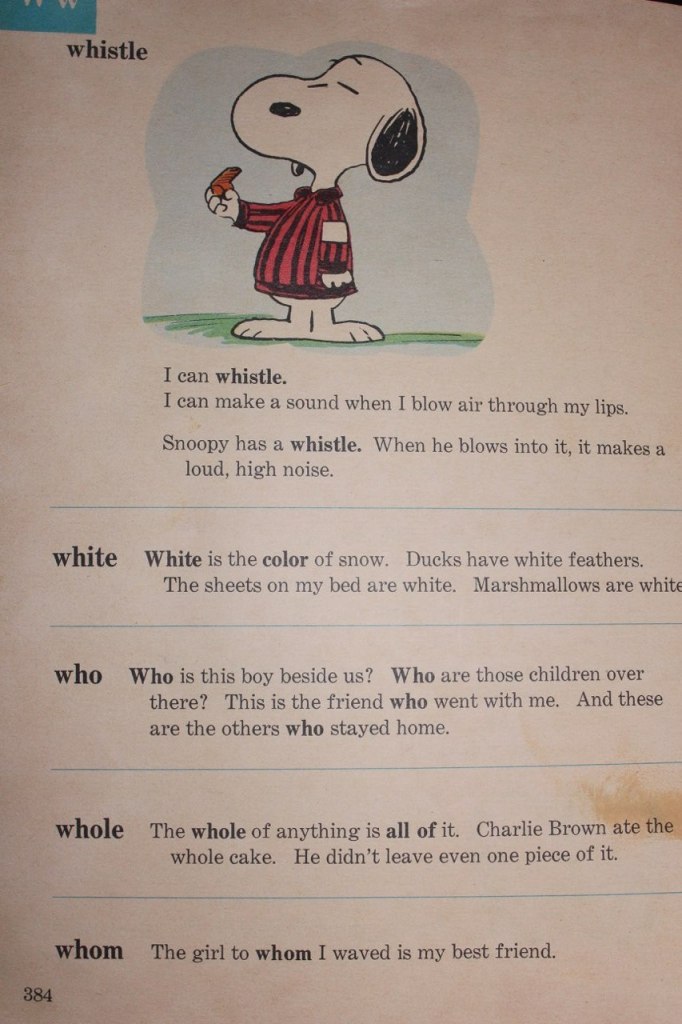
I then pull out the Charlie Brown dictionary- which always amazes them. (It amazed me too!) I add it to our classroom set of dictionaries. As time passes and they learn to define words and use them, I allow them to search the Charlie Brown dictionary.
As the year continues, the class grows older. The students are not new to third grade. They are fully third graders now.
Then one day, someone asks a question about identity – this always happens…someone is always curious about his or her self– and the class begins to argue and no one can come to a consensus. They turn to me and I turn to the dictionaries that they learned to trust and ask them if they ever looked up the words black or white. What do they think it means in a dictionary such as this one? I pull down the Charlie Brown dictionary.
The classroom is usually silent. Everyone thinking.
Then I flip the pages to white.
And read: White is the color of snow. Ducks have white feathers. The sheets on my bed are white. Marshmallows are white.
Next I turn the pages to black and read,
Franklin is Charlie Brown’s little black friend. He is talking to Charlie Brown on the telephone. Black is a color. Black is also another word for Negro, a person with dark skin. The words in this book are black.
The next thing that usually happens is a series of questions. Questions about what is in books and what images we accept without questions.
One year, the conversation happened after a trip to the New York Historical Society. The children were stunned to see a white educator – rather than a black one- teaching them about slavery in New York. They stood, uncertain, and couldn’t answer her questions. When we returned to the classroom, they expressed their discomfort with having a white educator telling them about their history.
Why did you feel uncomfortable? I asked.
Because, what was her ancestors doing when my ancestors were slaves? one little boy said quietly.
What do you think they were doing and why didn’t you ask her that?
A bossy girl at the front of the room replied, Because, that’s rude Ms. Hurley!
Why is that rude? Weren’t you uncomfortable? Was it okay for her to make you feel uncomfortable in your own skin? I’m not telling you to be rude. I am telling you to think. Think about your history and your stories and who is telling them and who will tell them if you don’t learn who you are.
Another year the conversation happened after singing the Black National Anthem. That was two years ago, when Trevor Noah and Roy Wood Jr. celebrated Franklin’s 50th year on the Daily Show. That was the same year the children learned the word stereotype.
Last year COVID happened right when the children started having the conversations. I thought, How can I introduce ‘race in America’ without the setting of the classroom? America quickly answered that question for me. Instead of discussing Franklin and Charlie Brown we cried about Floyd and Michael Brown, Jr.




You must be logged in to post a comment.