Harlem Studio Museum Practicum: A place of Service

IMG_0255

The fall of 2019,  was a season of wonderful opportunity. I reached a point of success in my career and to add motivation to joy I was accepted into the Harlem Studio Museum teaching practicum, a meeting ground for artist and educators to exchange thoughts and ask questions about art and artist.

The entire program was pure joy and a place of liberation. Everyone around me shared a keen interest in Black art and when we were not looking at art we were reading about it. The readings we delved into were not readings I would have came across in a DOE setting. It was a moment that was radical and renewing!

When we weren’t discussing art, we discussed ourselves. The small room was always full of meaningful chatter. We shared what it meant to show up as our happy selves and be paid for it. We thought deeply about the difference between conceptual mainstream artist and Black conceptual artist. We concluded in many conversations, that the market forces play an important role in the  work we see and don’t see.

Now, as I write this blog post, I think on that happiness I felt back then and I wonder, do people still show up as themselves anymore? Workplaces are changing drastically. We are also changing drastically…to be real and forthcoming does not seem the goal anymore.

Back in 2019, when I felt mostly settled and in true joy; I, transferred that energy into the classroom. Everything SMH exposed me to; I facilitated in the classroom. I developed strategies for children by using SMH theories and practices.

I was able to apply their theories and practices to my teaching because I understood it. The cohort was small and thus Ilk, our facilitator had  ample opportunity to explain theories. We learned each other names and made life long friendships. Because of this community, I was invited to travel to California to see an artist marry and I am currently working on a community project with another artist. I had space during this fellowship to  engaged in conversations about artists of African descent, contemporary art practices, and strategic museum programming.

As a teacher, I met other intelligent educators who were as passionate about art as I was. One educator asked me to submit my work to a Zine she was completing with a group of artist. Another one invited me to her first gallery show.

Our facilitator, Ilk, was enthusiastic about each topic and it showed up in each of his classes.

I was opened up to a whole new world about artist and their practice. What I enjoyed the most about the practicum was it gave me insight to how the museum world looked. Before the fellowship, as a teacher, I’d take my students to the museum and keep most of my questions about operation systems to myself. As a matter of fact, I always thought the museum world was untouchable and of the elite until I sat at the Harlem Studio Museum Practicum table.

Ilk peeled each skin of elitism off ever so gentle.

We attended special guest lectures with well established and up and coming artists such as Chole Bass and Douywe Bey. We were welcomed to different variations of the museum such as the reading room, their library, art in the park and learned of its connection with the Schomburg Research Center.

Now after this exposure, I look at museums as places of servitude. The art is answering to the people of the time and to the time itself.

Over all, it was a wonderful opportunity that is impactful even seven years later.

Fourth Grade at the Schomburg

The fourth grade read “The Man who Built a Library” by Carole Boston Weatherford and Eric Velasquez. This gave them insight on historical events and figures such as Benjamin Banneker, Fredrick Douglas and John James Audubon. It also opened them up to a world of history and research.

At the beginning of the year, when educators set a foundation for the rest of the year, is when i introduced the book. During this time, what is said, taught, and done is vital. How it’s said, taught, and done is significant. At the beginning of the book, Schomburg is introduced as a child and eventually he morphs into a man with one main mission and that is to prove that his history, Black history, does exist.

They learned that his books were stored at a research center in the heart of Harlem and are used today by people from all across the globe who are interested in learning about Black history. The Schomburg center is a place of learning and mental growth for all ages.

This will be our last trip class I told them when we finished reading the picture book.

When May came, we took a school bus from the Bronx into Harlem. Reading and reciting Langstong Hughes along the way. Once inside, with a feeling of relief and joy, we started off in the gallery scanning photos taken by Griff Davis. The students knew most of the subjects and looking at images help to give meaning to bigger-than- life figures like Langston Hughes and Dr. King.

The last photo we studied was of Hughes standing amongst students in an auditorium at a school in Georgia.

Through this image they learned of themselves as well as the history of Black Independent schools. They spoke of Thurgood Marshall and the segregation of education.

After the discussion, they were asked to write poetry about Education and what it meant to them. Their work consisted mostly of themes about education and history and society.

The following was written by Zahyra Webley.

The Star in the night

They won’t let my people go to school

I’ll make one.

You won’t make me go to work

I’ll make one.

My people are stars let us be free,

freer than anyone

I will stand up and

do this work for my

PEOPLE!

After hearing them read their poetry, Ms. Hill, the Schomburg’s educational coordinator, lead them through a short libation in the rotunda.

I don’t know what went through their heads knowing that Langston Hughes ashes sat beneath them. They followed her hands as she pointed out the rives that connected us as a people.

She spoke to them about a poem we didn’t cover in class: The Negro Speaks of Rivers

As a close, the students followed her into the auditorium and once situated, they read poetry that they wrote. Some read the poem they worked on in class while others read poetry they wrote in the gallery while looking at the photo of Langston Hughes. One student read of her crush in a whispered giggle that sent off glances through out the room while another read Paul Laurence Dunbar’s “Merry Autumn”. But for the most part all of them read their work.

When I checked their evaluation forms for the trip this is what some of them said:

Bob the Photographer

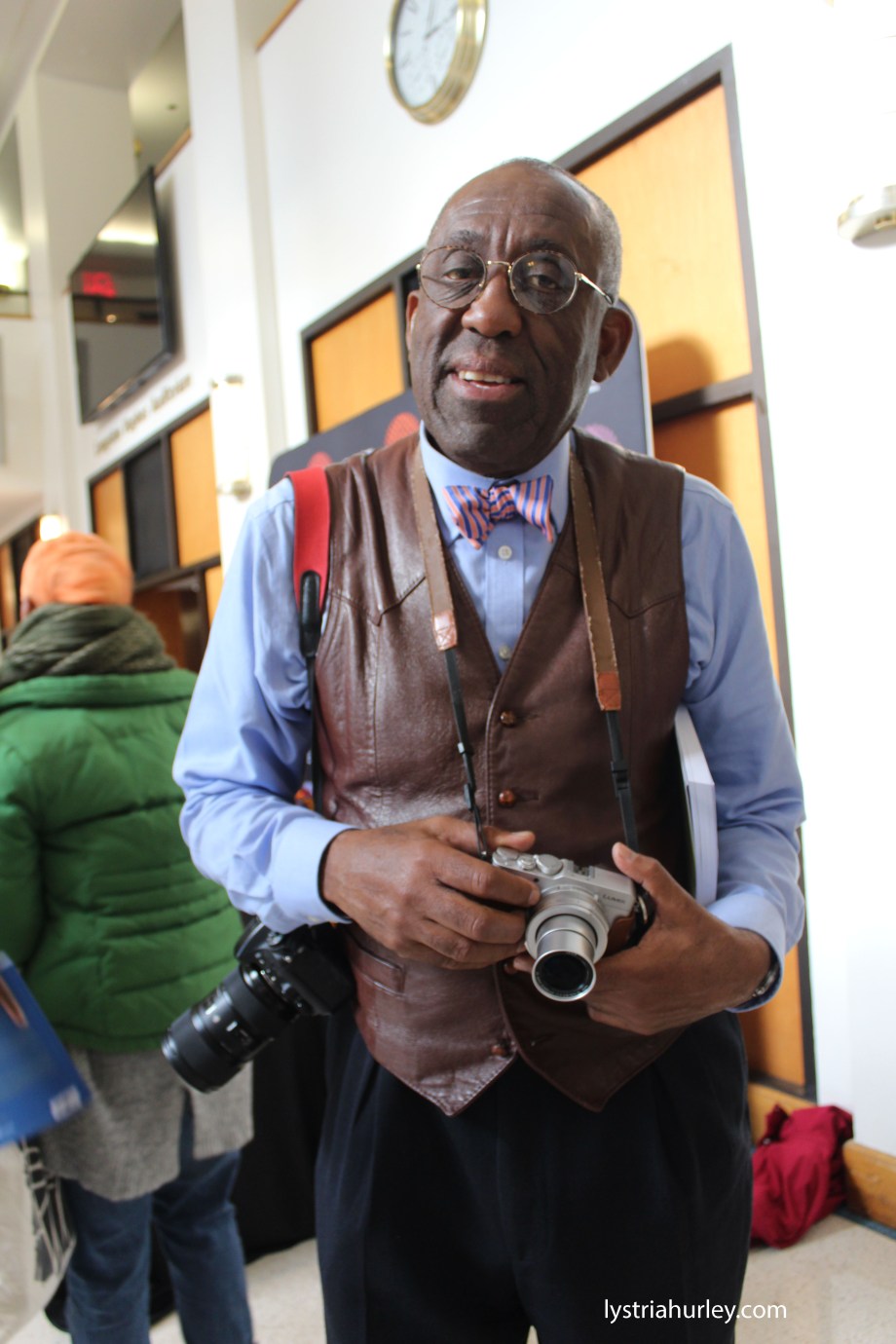
BobI met Bob at the Schomburg in Harlem. He was photographing for an event. I was looking for the restroom. The second time I passed him, he said to me, “You look just like your mom”.

Really? And who is my mom?

What you mean, who is your mom?

You know my mom?

Yes, doesn’t she lead the student organization over at the-

No. 

I didn’t want to tell him my mom was indeed in heaven. He looked at me blankly.

Aren’t you from Eritrea?

No. I get that all the time. But I’m not. 

You’re not the high school student whose mom leads the organization for high school students?

No, as a matter of fact, I’ve been out of high school for over 15 years.

Wow! You look just like her daughter!

He couldn’t stop looking at me. I thought the entire situation was kinda funny. When I told my friend, Kieara what happened, she responded, sometimes, when you have moments like that, it’s just to remind you about your mom and how often she would think of you. 

Which I would love to always remember. I told her about the time the little boy in preschool, whom I never saw before, said to me.

Wow! You look just like your mom!

Really, little boy?

Yes.

And where is my mom?

You look just like her!

He never told me where my mom was. He just kept telling me I looked like her.

Harry Belafonte


Over the weekend when I went to the Schomberg Center to view 100 Moments, I ran into American singer, songwriter, actor and social activist  Harry Balafonte!!

I felt really good because I was looking at Gordon Parks pictures wishing I could have met Gordon Parks when all of sudden I looked up and saw Mr. Belafonte! It was so random and even though they are two different people and are recognized for different achievements, It feels good meeting a celebrity that you actually can connect with.

100 Moments


This year, if he was still alive, Gordon Parks would have turned 100 years old.

I went to Harlem, 135th Street, and visited the  Schomburg Center to view the Gordon Parks photo exhibition titled, 100 Moments. Each moment I spent in the center was inspiring.

I think the most encouraging part for me was listening to the short documentary of Parks life. I took some notes on his views of photography and his work. Listening to the video made me understand why I love his work: I find myself, he said, speaking for poor people who can’t speak for themselves…and in that way I speak for myself.  He continued, I am an objective reporter with a subjective heart. My emotions, he said, get in the way but I don’t allow them to dominate.

When I was in High School, I wanted to meet him but never got the chance as he died the year I graduated.

The photo I enjoyed the most is titled: Music: That Lordly Power 1993. Maybe it spoke to how I was feeling right then. I know it’s an image I am not going to forget.

Kudos to Deborah Willis who put together a brilliant show.